The tour guide took us into the Civic Museum for a tour. Siena was ruled by nine leaders and there were nine columns that converged to the Palazzo Publico.
 Inside is where the horses converge prior to the Palio race. Siena is divided into contradas (think houses at a fancy boarding school but on a city level) which each has a horse and jockey that race. Horses are randomly selected, jockeys are picked, and the starting order is randomly selected. When wondering through town each contrada area has lamp posts which are painted their specific color. Despite being mostly luck, the contradas take great pride when their horse wins. As we entered the building there was large carving of Romulus and Remus with the she-wolf, this image seems to be everywhere in Siena.
The first room we entered was the Hall of Italian Unifcation. There is a graphic fresco of the Battle of San Martino on one wall and illustrations of Victor Emmanuel II. The 19th century paintings were the most recent on our tour.
In the next area we entered there were large frescos covering every inch of wall and depicting the entire history of the region. Two of the frescos of particular interest were of St Catherine of Siena and St. Bernardino. I read a bit about Saint Catherine and she seems, perhaps like most saints, bizarre.
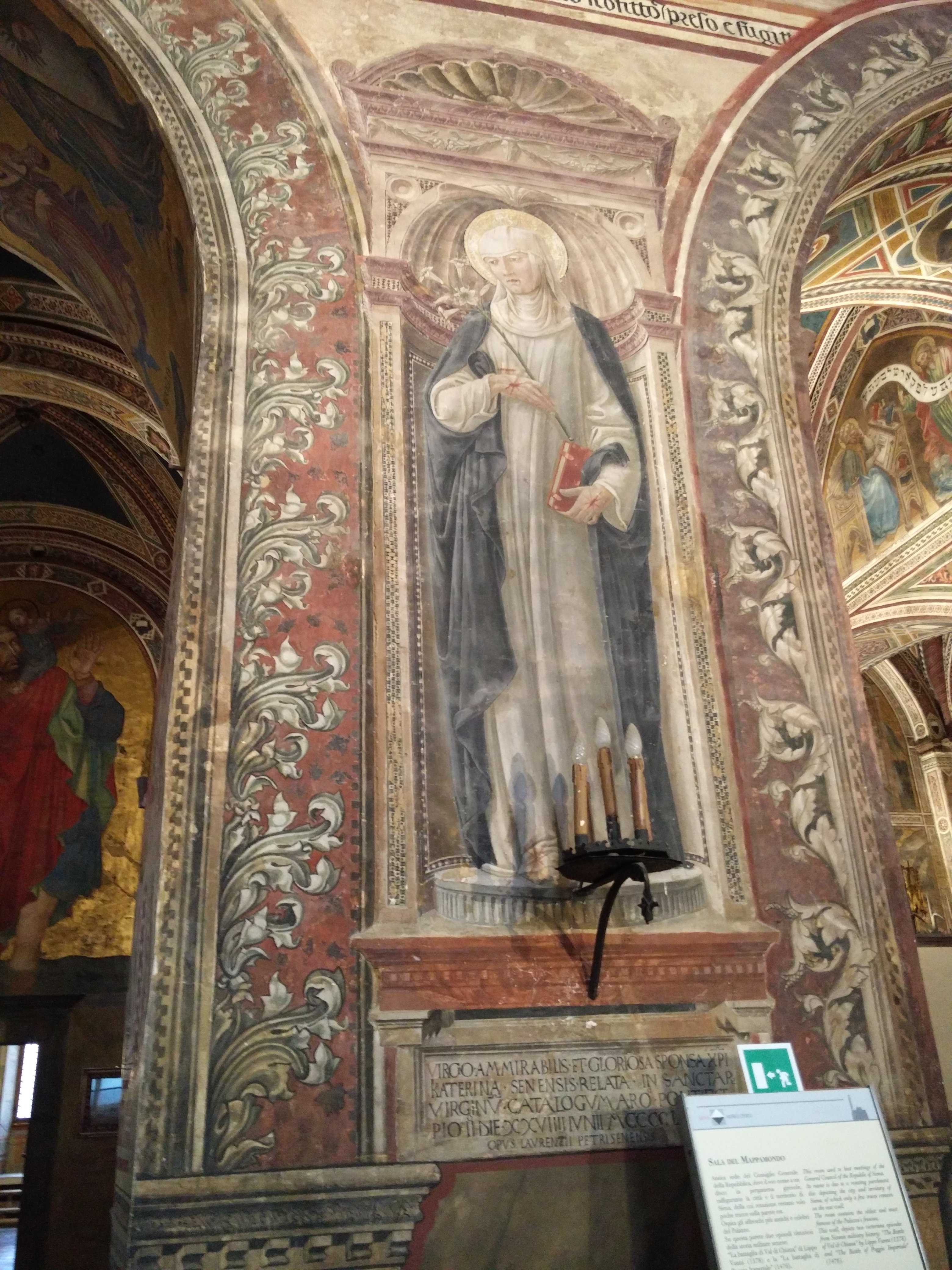
St. Catherine of Siena
Anyway, we ventured next to the Sala della Paca or Sala dei Nove (the hall of peace or hall of nine for you English speakers). It refers to the Council of Nine who rule Siena in the 14th century. The frescos were breathtaking. One wall told the story of what it is like when good government rules while the opposing wall told the story and dangers of a bad government, these frescos are aptly named “Allegory of Bad Government” and “Allegory of Good Government.” The council ruled from 1287-1355 and met in this room- how’s that for a history lesson?!
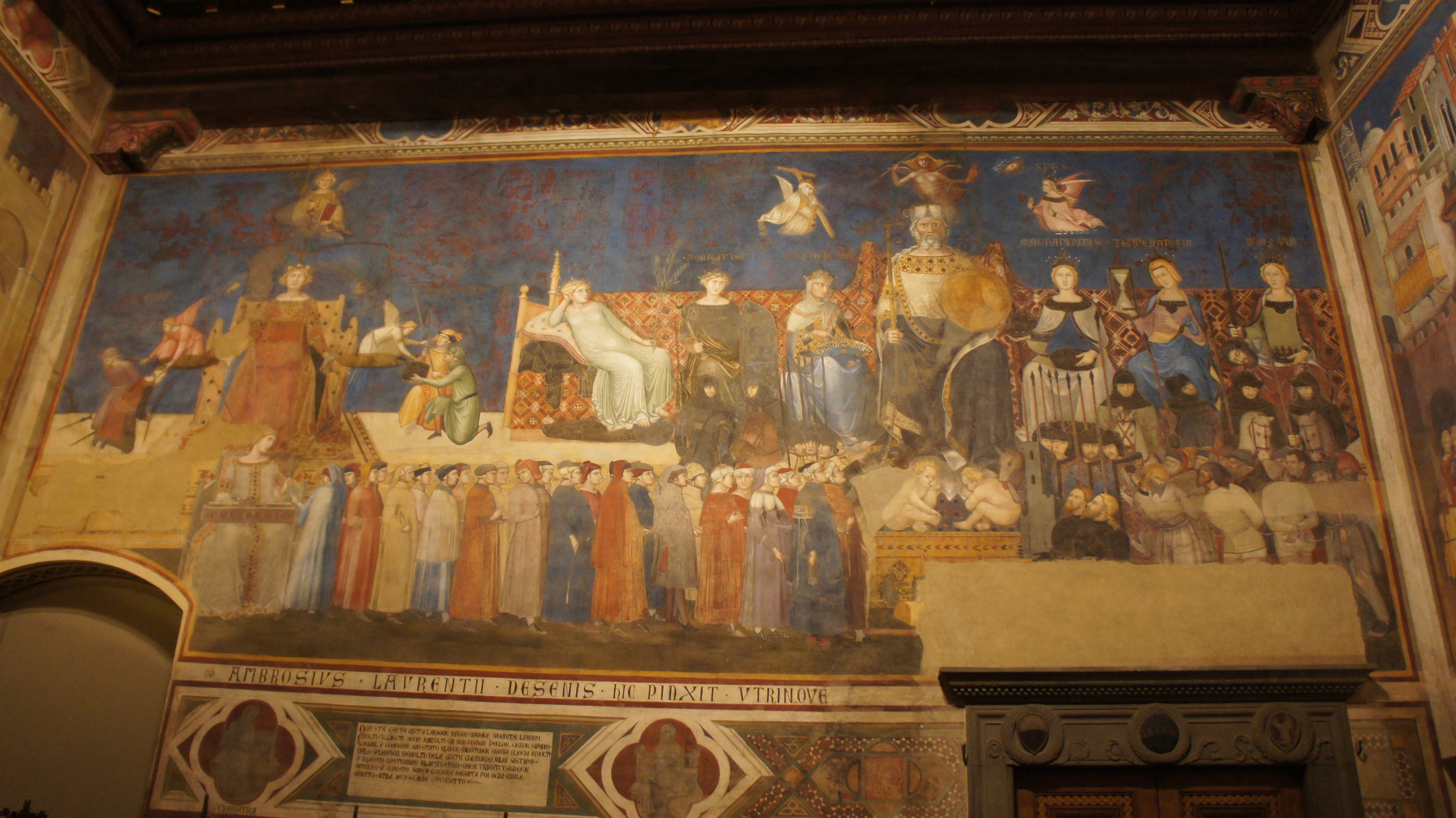
Allegory of Good Government- Siena is the bearded guy on the throne and is surrounded by six virtues
After the tour in the Civic Museum we walked to the Duomo of Sienna which is Saint Mary of the Assumption. The Assumption of Mary is a Catholic holy day occurring on August 15th (if you remember your lessons from Father Bob) and, therefore, the Palio horse race takes place on the 16th. Construction of the cathedral began sometime in the 1220s. On each sides of the façade of the church are two tall columns again depicting Romulus and Remus and connecting the city to both the pagan tradition and, more importantly, to Rome. The church was begun during the gothic period and continued during the Romanesque period so the church has combination of both gothic (pointy) and Romanesque (curvy) arches. To the right of the cathedral is a large wall with gigantic arches which was supposed to be an expansion project. Unfortunately the plague hit circa 1300s knocking out half of the city of Siena and the kibosh was put on the project- despite being short on manpower, they felt God was punishing their pride.
After the tour, we headed back for a quick change at the hotel and Nina and I headed to Il Pomodorino for pizza, courtesy of a suggestion from Rick Steve’s guide book. As always, Rick did not lead us astray. We ordered a white pizza with truffles and a red pizza with prosciutto, arugula (known in the English translation as Rocket) and parmesan.
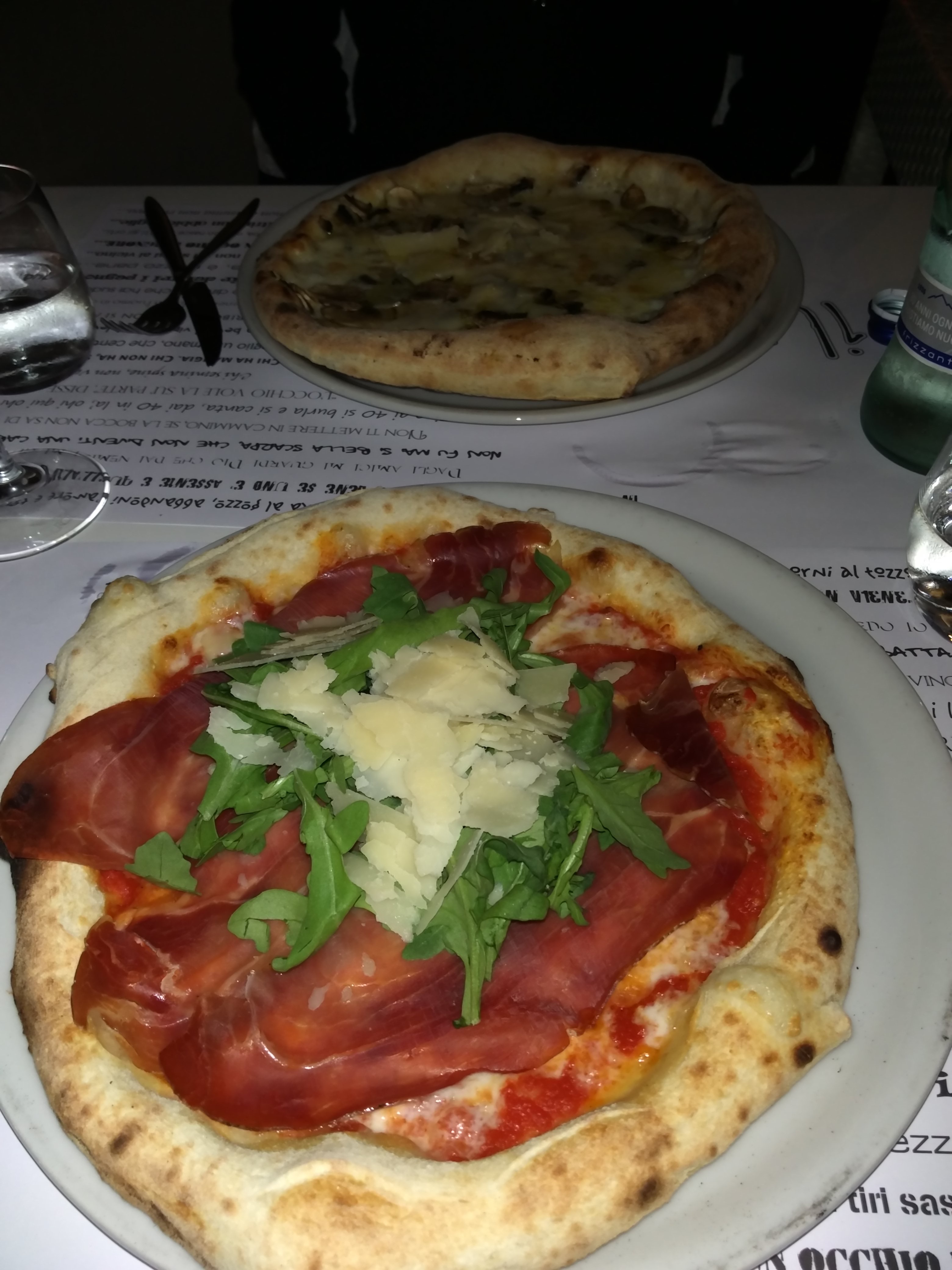
Nobody does pizza like the Italians.
We split a bottle of the house wine- a smooth red that was perfecto. Our view from the table overlooked the cathedral. Given recommendations from the hotel the rest of our travel group ended up at the same restaurant and we ended up pushing the tables together and having a fun night. It was a hilly walk back to the hotel and time for a good night’s rest.
One Response to Day 4, part due